|
|
|
|
By David R. Butcher
The weeks leading up to the end of the year force many workers to meet tight, often unreasonable, deadlines. Here are seven ways to survive the avalanche of work before the new year.
Many of us deal with tight deadlines or intimidating projects on a regular basis, and it only gets worse in the final weeks of the year. The pressure can often be overwhelming. Managing multiple projects and deadlines at work is stressful, so it is important to develop a smart strategy and organize your schedule.
Here are seven ways to help get a handle on tight deadlines.
1) Prioritize tasks. Some tasks are crucial and some are not. We tend to gravitate to the «not crucial» items because they are often quicker, easier and more fun to do. Instead, carefully set priorities based on «high-payoff» activities and use them as a basis for making decisions. Figure out your top goal and focus on that first, then tackle the rest of your assignments in the order of importance.
2) Break down the work. If a task seems daunting, break the large, time-consuming job into smaller tasks. «Split the whole into parts, the parts into bits and the bits into morsels,» productivity blog Half-a-Dozen Monkeys recommends. Work on each segment a few minutes at a time until they’re all done. For instance, rather than set «Finish meeting presentation» as your goal, zero in on each task involved in finishing that presentation and focus on them separately.
3) Use your tools. «Your time management tools cannot have your back if you don’t use them,» productivity expert Craig Jarrow writes at Time Management Ninja. «Keep your to-do list visible, and pick tools that you’ll enjoy using.» Some people prefer to keep things simple and write a to-do list on paper, while others take advantage of one of the many software tools or online task-management tools available to keep a digital list. Figure out which method works best for you.
4) Plan ahead. Plan tomorrow today. Before you go home each evening, spend a few minutes looking at all that you have to do and want to do the next day, and with each item ask yourself if it’s the best use of your time. If it is, do it. If it isn’t, try to arrange a way to delegate it to someone else. «Take the time each night to take control of the most precious resource at your command: the next 24 hours,» Dr. Donald Wetmore, creator of the Productivity Institute, writes in Ten Time Savers. «Plan your work and then work your plan each day.»
5) Ask for help. With the holidays right round the corner, tap into coworkers’ giving spirits. «The quickest way to halve the time [needed] to do something? Double the number of people working on it!» Half-a-Dozen Monkeys says. «Get a colleague, a friend or even a boss to role their sleeves up — if you make people aware you need help, they will often do all they can.»
6) Manage expectations. Accept that you may not get everything done before the office closes for the holidays. However, keep in mind that your boss likely doesn’t want to be told that you can’t meet a deadline without some indication of what you can do. «Instead of just saying a deadline is impossible,» U.S. News & World Report suggests, «try saying something like, ‘With only 10 days, I can do X and Y, and I’ll need to modify Z in the following ways. And we won’t have finished fully testing it, but that could be wrapped up two days later. Would that work?'»
7) Understand the positive power of tight deadlines. Many of us must multitask and work on multiple projects every day. However, keep in mind that a tight deadline, while stressful, can also ignite creativity, reduce wasted time, encourage teamwork, build confidence and even lead to finishing a task or project early, giving the worker more time to review and even re-work. «By keeping tight deadlines, you will increase your productivity and get more done,» Jarrow writes. «Sometimes it takes a tight deadline to make the impossible happen.»
Источник: http://news.thomasnet.com
…и бонус:

|
|
|
|
Words to Avoid on Your LinkedIn Profile
If you want a potential employer to know how creative you are, don’t use «creative» or «innovative» on your LinkedIn profile, as these tired descriptors are so overplayed in professionals’ online profiles that they do little to distinguish job seekers.
Based on a recent analysis of its 135 million members’ profiles, the business networking site determined that the most overused words or phrases by United States-based professionals are:
Creative;
Organizational;
Effective;
Extensive experience;
Track record;
Motivated;
Innovative;
Problem solving;
Communication skills; and
Dynamic.
In LinkedIn’s 2010 study, words and phrases like «extensive experience,» «dynamic,» «motivated» and «innovative» topped the list of the most overused buzzwords in various countries.
One problem with such these buzzwords and phrases — like all gibberish business jargon — is that they have lost some of their meaning with overuse. Another problem is that they are not specific to one type of skill, and are in fact so vague that they can be used to describe anyone and everything — exactly what you don’t want when you’re applying for a job.
Источник: http://news.thomasnet.com
|
|
|
|
|
Пока «лежит» привычный и любимый Мультитран.ру, пошла было на Мультилекс.ру, а он редиректит на сервис ABBYY (ABBYY поглотила Мультилекс?): http://lingvopro.abbyyonline.com.
Диапазон граней на каждую единицу, конечно, существенно меньше, чем в Мультитране (мне лично не хватает еще 20-30 значений слова, чтобы прочувствовать его как можно глубже), зато удобно выводятся примеры из базы параллельных текстов.
|
|
|
|
|
Такая игра слов — почти идеальное средство для убийства переводчика!
|
|
|
|
САНА /Йемен/, 21 ноября. /Корр. ИТАР-ТАСС Валерий Жуков/. Российские ученые-лингвисты готовят к изданию первый том антологии фольклорных текстов на уникальном языке коренных жителей йеменского острова Сокотра в Индийском океане. Об этом корр. ИТАР-ТАСС сегодня сообщил заведующий кафедрой истории и филологии Древнего Востока института восточной культуры и античности Российского государственного гуманитарного университета /РГГУ/, ведущий научный сотрудник института востоковедения РАН /ИВ РАН/ Леонид Коган, который в этом году продолжил изыскания в составе Российской комплексной экспедиции в Йеменской Республике.
«Завершившийся полевой сезон на Сокотре, несмотря на его краткость из-за известных событий в этой арабской стране, можно считать успешным. Нам практически вдвое, до 23, удалось увеличить количество фольклорных текстов, которые лягут на страницы первого тома антологии вместе с комментариями и словарем. Один том будет включать в себя порядка 30 текстов», — отметил российский ученый.
По словам Когана, сокотрийский язык /сокотри/ является одним из самых архаичных и обособленных в западной ветви семитской семьи группы южноаравийских языков. «В эту группу также входят языки коренного населения Махры, Дофара и островов Курия-Мурия в южной части Аравийского полуострова. Они резко отличаются от других и являются свидетелями самого раннего расселения семитских племен, скорее всего, в первых веках нашей эры», — пояснил он.
Коган отметил, что сокотри был открыт в 1838 году, и тогда же были впервые записаны 200 слов на этом языке. «Работая с информантами по фольклорным текстам мы только за этот сезон собрали десятки новых слов, которые попадают в базу для создания словаря сокотрийского языка. Наряду с антологией, словарь — это те направления лингвистической деятельности экспедиции, которые были намечены известным российским ученым и признанным экспертом по проблемам арабского мира, директором ИВ РАН Виталием Наумкиным еще в 80-е годы прошлого века», — подчеркнул он.
Коган рассказал, что именно его старший коллега впервые стал рассматривать тексты сокотрийских сказок, преданий не только с точки зрения лингвистики, но и как ценнейшие фольклорные источники. «Наумкин также стал инициатором приглашения информантов-сокотрийцев непосредственно в Москву, где они в течение нескольких месяцев вплотную работали с российскими лингвистами. А реализации этого проекта содействует «Фонд фундаментальных лингвистических исследований, возглавляемый Кириллом Бабаевым», — добавил он.
Леонид Коган не исключает возможности того, что сокотрийский язык обретет письменность на основе арабского алфавита. «Для этого нужно только добавить в алфавит несколько новых букв и убедить власти страны в необходимости таких шагов, направленных на сохранение и развитие уникального языка», — заключил российский ученый.
© ИТАР-ТАСС. Все права защищены
тел. +7 (499) 791 0307, 791 0308, 791 0310; факс: +7 (499) 791 0303
rusmarket@itar-tass.com
Источник: http://www.itar-tass.com/c11/277151.html
Удивительно, что где-то на этой же планете существуют увлеченные люди, искренне и самозабвенно занимающиеся лингвистическими исследованиями в полевых условиях. Описанная в статье работа сама по себе интересная, но вот бы и срез обнюхать, ознакомиться со сказками.
Интересно, как те или иные ученые оказываются затянутыми в сети тех или иных редких языков, которые выбрали именно их для изучения своих пластов? И есть ли у читателей этого блога свои похожие истории, пусть если не собственные, то услышанные от кого-то?
|
|
|
|
|
Дельфины как пример иного разума
Автор: Юрий Михайлов
Опубликовано 05.12.2011 в блоге «Компьютерры»
То, что животные разговаривают друг с другом, – давно доказанный факт. Можно вспомнить хотя бы язык луговых собачек. Эти грызуны передают друг другу вполне осмысленные сообщения – такие, как, например, «вот идёт большой человек в красном». В том, что дельфины общаются между собой, никто не сомневался, и вот, наконец, их язык частично расшифрован. И он совершенно не похож на человеческий!
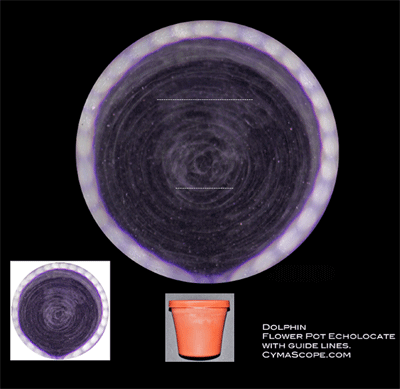
Образ горшка, переданный дельфином
Американские и британские исследователи смогли обучить дельфинов комплексным предложениям, состоящим из существительных и глаголов, транслируя им записанные эхолокационные сигналы. Таким образом, эти животные способны понимать человеческий язык, и к тому же у них есть свой собственный визуальный язык, который даже, наверно, нельзя назвать языком.
Известно, что дельфины способны с помощью эхолокации получать звуковые образы определённых объектов и передавать их друг другу, имитируя отражённый ультразвуковой сигнал. Каждый из этих звуков является голографическим представлением объекта.
Разумеется, просто передача звуковых «голограмм» – это ещё не язык. Но Джек Кассельвиц, один из учёных, работающих над изучением того, как дельфины общаются, говорит, что дельфины передают с помощью ультразвуковых образов всю необходимую информацию, так что мозг животного распознаёт этот сигнал как картинку.
«Наша новая модель языка дельфинов заключается в том, что они способны не только посылать и принимать образы объектов вокруг них, но создавать независимые звуковые картины, представляя то, о чём они хотят сообщить, – говорит Кассельвиц. – Для нас, людей, сложно дистанцироваться от нашей модели мышления символами, чтобы понять, каким образом дельфины мыслят целостными картинами. Наши личные верования, идеология и воспоминания пронизывают наше общение, включая описания чего-либо и понимания каких-либо вещей. Дельфины, похоже, преодолели стадию человеческого языка и изобрели форму общения, не похожую на нашу. Фраза «лучше один раз увидеть, чем сто раз услышать» приобретает новое значение».
В отличие от человеческих языков, дельфины из любой точки света способны понимать друг друга, в то время как у нас существует куча диалектов и человек из другой языковой группы не способен понять собеседника из другой. Развитие речи учёные связывают с увеличением головного мозга, и долгое время было непонятно, почему у дельфинов такой большой мозг, притом что их «язык» был до сих пор непонятен человеку. Теперь же Кассельвиц утверждает, что такой большой мозг этих животных предназначен именно для комплексного общения с помощью звуковых картин.
Сам Кассельвиц говорит: «Наши исследования отвечают на давний вопрос доктора Джилл Тартер из института SETI: одни ли мы во Вселенной? Теперь мы точно можем заявить, что нет. Поиск иного разума увенчался на Земле».
Дальше источник по-английски:
The Discovery of Dolphin Language
28th November 2011
Researchers in the United States and Great Britain have made a significant breakthrough in deciphering dolphin language in which a series of eight objects have been sonically identified by dolphins. Team leader, Jack Kassewitz of SpeakDolphin.com, ‘spoke’ to dolphins with the dolphin’s own sound picture words. Dolphins in two separate research centers understood the words, presenting convincing evidence that dolphins employ a universal “sono-pictorial” language of communication.
The team was able to teach the dolphins simple and complex sentences involving nouns and verbs, revealing that dolphins comprehend elements of human language, as well as having a complex visual language of their own. Kassewitz commented,
We are beginning to understand the visual aspects of their language, for example in the identification of eight dolphin visual sounds for nouns, recorded by hydrophone as the dolphins echo located on a range of submersed plastic objects.
The British member of the research team, John Stuart Reid, used aCymaScope instrument, a device that makes sound visible, to gain a better understanding of how dolphins see with sound. He imaged a series of the test objects as sono-pictorially created by one of the research dolphins. In his bid to “speak dolphin” Jack Kassewitz of SpeakDolphin.com, based in Miami, Florida, designed an experiment in which he recorded dolphin echolocation sounds as they reflected off a range of eight submersed objects, including a plastic cube, a toy duck and a flowerpot. He discovered that the reflected sounds actually contain sound pictures and when replayed to the dolphin in the form of a game, the dolphin was able to identify the objects with 86% accuracy, providing evidence that dolphins understand echolocation sounds as pictures. Kassewitz then drove to a different facility and replayed the sound pictures to a dolphin that had not previously experienced them. The second dolphin identified the objects with a similar high success rate, confirming that dolphins possess a sono-pictorial form of communication. It has been suspected by some researchers that dolphins employ a sono-visual sense to ‘photograph’ (in sound) a predator approaching their family pod, in order to beam the picture to other members of their pod, alerting them of danger. In this scenario it is assumed that the picture of the predator will be perceived in the mind’s eye of the other dolphins.
When Reid imaged the reflected echolocation sounds on the CymaScope it became possible for the first time to see the sono-pictorial images that the dolphin created. The resulting pictures resemble typical ultrasound images seen in hospitals. Reid explained:
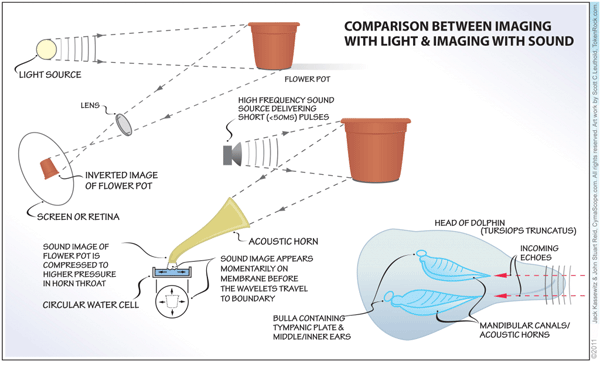
When a dolphin scans an object with its high frequency sound beam, emitted in the form of short clicks, each click captures a still image, similar to a camera taking photographs. Each dolphin click is a pulse of pure sound that becomes modulated by the shape of the object. In other words, the pulse of reflected sound contains a semi-holographic representation of the object. A portion of the reflected sound is collected by the dolphin’s lower jaw, its mandible,where it travels through twin fat-filled ‘acoustic horns’ to the dolphin’s inner ears to create the sono-pictorial image.
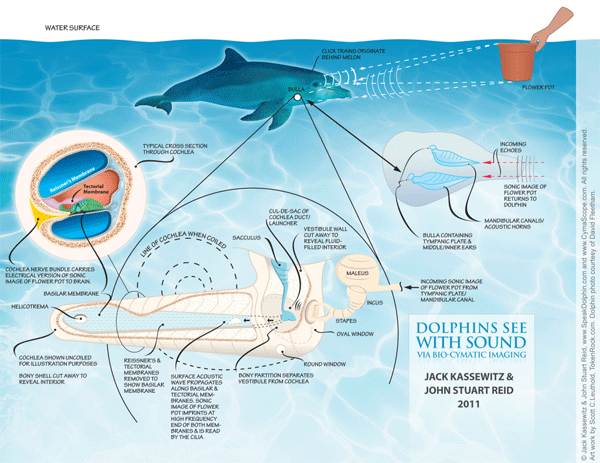
The precise mechanism concerning how the sonic image is ‘read’ by the cochleae is still unknown but the team’s present hypothesis is that each click-pulse causes the image to momentarily manifest on the basilar and tectorial membranes, thin sheets of tissue situated in the heart of each cochlea. Microscopic cilia connect with the tectorial membrane and ‘read’ the shape of the imprint, creating a composite electrical signal representing the object’s shape. This electrical signal travels to the brain via the cochlea nerve and is interpreted as an image. (The example in the graphic shows a flowerpot.) The team postulates that dolphins are able to perceive stereoscopically with their sound imaging sense. Since the dolphin emits long trains of click-pulses it is believed that it has persistence of sono-pictorial perception, analogous to video playback in which a series of still frames are viewed as moving images.
Reid said, “The CymaScope imaging technique substitutes a circular water membrane for the dolphin’s tectorial, gel-like membrane and a camera for the dolphin’s brain. We image the sono-picture as it imprints on the surface tension of water, a technique we call ‘bio-cymatic imaging,’ capturing the picture before it expands to the boundary. We think that something similar happens in the dolphin’s cochleae where the sonic image, contained in the reflected click-pulse, travels as a surface acoustic wave along the basilar and tectorial membranes and imprints in an area that relates to the carrier frequency of the click-pulse. With our bio-cymatic imaging technique we believe we see a similar image to that which the dolphin sees when it scans an object with sound. In the flowerpot image the hand of the person holding it can even be seen. The images are rather fuzzy at present but we hope to enhance the technique in future.
”Dr Horace Dobbs is Director of International Dolphin Watch and a leading authority on dolphin-assisted therapy.
I find the dolphin mechanism for sonic imaging proposed by Jack Kassewitz and John Stuart Reid plausible from a scientific standpoint. I have long maintained that dolphins have a sono-visual language so I am naturally gratified that this latest research has produced a rational explanation and experimental data to verify my conjectures. As early as 1994, in a book I wrote for children, Dilo and the Call of the Deep, I referred to Dilo’s ‘Magic Sound’ as the method by which Dilo and his mother pass information between each other using sonic imaging, not just of external visual appearances, but also of internal structures and organs.
As a result of Reid’s bio-cymatic imaging technique Kassewitz, in collaboration with research intern Christopher Brown, of the University of Central Florida, is beginning to develop a new model of dolphin language that they are calling Sono-Pictorial Exo-holographic Language, (SPEL). Kassewitz explained,
The ‘exo-holographic’ part of the acronym derives from the fact that the dolphin pictorial language is actually propagated all around the dolphin whenever one or more dolphins in the pod send or receive sono-pictures. John Stuart Reid has found that any small part of the dolphin’s reflected echolocation beam contains all the data needed to recreate the image cymatically in the laboratory or, he postulates, in the dolphin’s brain. Our new model of dolphin language is one in which dolphins can not only send and receive pictures of objects around them but can create entirely new sono-pictures simply by imagining what they want to communicate. It is perhaps challenging for us as humans to step outside our symbolic thought processes to truly appreciate the dolphin’s world in which, we believe, pictorial rather than symbolic thoughts are king. Our personal biases, beliefs, ideologies, and memories penetrate and encompass all of our communication, including our description and understanding of something devoid of symbols, such as SPEL. Dolphins appear to have leap-frogged human symbolic language and instead have evolved a form of communication outside the human evolutionary path. In a sense we now have a ‘Rosetta Stone’ that will allow us to tap into their world in a way we could not have even conceived just a year ago. The old adage, ‘a picture speaks a thousand words’ suddenly takes on a whole new meaning.
David M. Cole, founder of the The Aqua Thought Foundation, a research organization that studied human-dolphin interaction for more than a decade said,“Kassewitz and Reid have contributed a novel model for dolphins’ sonic perception, which almost certainly evolved out of the creature’s need to perceive its underwater world when vision was inhibited. Several conventional linguistic approaches to understanding dolphin communication have dead-ended in the last 20 years so it is refreshing to see this new and highly-nuanced paradigm being explored.”
The human capacity for language involves the acquisition and use of a complex system of vocal sounds to which we attribute specific meanings. Language, the relationship between sounds and meanings evolved differently for each tribe of humans and for each nation. It is generally believed that the human language faculty is fundamentally different from that of other species and of a much higher complexity. The development of vocal language is believed to have coincided with an increase in brain volume. Many researchers have wondered why dolphins have brains comparable in size with those of humans, considering that Nature creates organs according to need. The Kassewitz team’s findings suggest the large dolphin brain is necessary for the acquisition and utilization of a sono-pictorial language that requires significant brain mass.
Dolphins enjoy constant auditory and visual stimulation throughout their lives, a fact that may contribute to their hemispheric brain coordination. The dolphin’s auditory neocortical fields extend far into the midbrain, influencing the motor areas in sucha way as to allow the smooth regulation of sound-induced motor activity as well as sophisticated phonation needed for production of signature whistles and sono-pictures. These advantages are powered not only by a brain that is comparable insize to that of a human but also by a brain stem transmission time that is considerably faster than the human brain.
Kassewitz said,
Our research has provided an answer to an age-old question highlighted by Dr Jill Tarter of the SETI Institute, ‘Are we alone?’ We can now unequivocally answer, ‘no.’ SETI’s search for non-human intelligence in outer spacehas been found right here on earth in the graceful form of dolphins.
Full results of this research are available on request. Please email either Jack Kassewitz or Stuart Reid.
Jack Kassewitz: speakdolphin@mac.com
Stuart Reid: john@sonic-age.com
|
|
|
|
|
Только вчера я в Дневнике посетовала, что бюро переводов не отвечают на мои письма, отправленные по объявлениям. Сегодня получила вот это (на админский ящик и от тех, кому никогда не писала):
Здравствуйте, admin@trworkshop.net!
Я Виталий Педченко, заместитель директора компании […], в которой я проработал более десяти лет. Я пишу Вам, потому что Вы подавали заявку на одну из наших вакансий и, возможно, эта информация будет ценна для вас или ваших друзей.
Отбор в нашу компанию проходит один человек из ста. Но, проанализировав результаты, я понял, что не всегда виноваты соискатели. Часто, они просто не знают, как искать работу, выполнять тесты, проходить собеседования.
Хочу поделиться с Вами своими наблюдениями о процессе отбора персонала в нашей компании. Хорошие перспективные переводчики просто не понимают, как составить резюме (чего стоят ошибки вроде «English: advansed» или фото в купальнике). Иногда нам пишут с адреса вроде pavlik-ravlik@ или Nimfomanka87@, на что рассчитывают такие соискатели?
Сейчас похолодало и к нам уже не приходят соискатели в шортах, но летом такое случалось. Деловой стиль — все еще лучший вариант для собеседования.
Если переводчику выслали тестовый перевод, это не значит, что кто-то хочет получить три абзаца перевода бесплатно. Я не перестаю удивляться количеству людей, которые всерьез думают, что мы каким-то образом используем их тестовые переводы.
Сейчас в моде автоматические переводчики, но даже великий Google не сможет заменить человека. Часто забывают вычитать текст. Если через весь текст проходит красной линией: «сделаю как-нибудь, может пройду», то хочется посоветовать таким соискателям не тратить зря и свое время, и время HR-менеджера.
Мы не просто так высылаем всем соискателям достаточно большую инструкцию, которая должна помочь им в переводе, жаль, что они ее не используют, она содержит огромное количество полезных советов.
Если же вы подавали заявку на переводческую вакансию, то для вас будет интересна моя книга. Когда я создавал электронную книгу «TranslatorStart – Как стать штатным или удаленным переводчиком», я преследовал наши самые эгоистичные цели: получить больше опытных соискателей, которых мы бы взяли на работу. Была даже идея распространять ее бесплатно, но я от нее отказался, т.к. бесплатные знания никто не ценит. Цена была установлена такая, чтобы не отпугнуть читателей, но, чтобы человек обязательно прочел книгу, т.к. он за нее заплатил.
Эта книга объясняет, чего хотят работодатели от переводчиков, какими программами должен владеть соискатель, как ему улучшать свои знания.
Вы знаете, почему так много лингвистов и филологов работают не по специальности? Почему после окончания ВУЗа они испытывают полное разочарование?
Все очень просто – подготовленные специалисты не знают, как дорого продавать свои услуги, выгодно продавать себя. Вчерашние студенты скованы своими недостаточными знаниями и отсутствием специализированного программного обеспечения.
Если кратко, то эта книга поможет вам:
* Начать карьеру штатного или дистанционного переводчика
* Узнать какие требования выдвигают работодатели и клиенты
* Научиться искать работу эффективно и найти ее
* Понять, как формировать цены на свои услуги, и какую зарплату требовать
* Узнать, как успешно работать с иностранными клиентами через Интернет
* Научиться получать оплату за свою работу
* Узнать, что можно и чего нельзя делать переводчику
* Научиться создавать профессиональное резюме лингвиста
* Найти сайты, на которых вы сможете легко и быстро получить работу
* Перестать зависеть от вашего местонахождения и начать работать со всем миром
И многое другое, что непременно поможет вам сделать успешную карьеру в переводческом бизнесе.
Посетите мой блог прямо сейчас, и вы узнаете больше о книге, а также найдете советы соискателям: [ссылка]
Пишите мне, если у Вас есть какие-либо вопросы, я пишу с личного адреса, Вам нужно просто нажать кнопку «Ответить».
Хорошей рабочей недели! 🙂
С уважением,
Виталий.
Чуть позднее пришло не менее чудесное письмо аж оттуда:
Dear Sirs,
Good day!
This is Ms Chris,we are a fan factory from Guangdong, China (we are doing:stand fan,box fan,table fan,orbit fan,wall fan,clip fan and industrial fan ……son on). We do this line more than ten years,we hope we could get a chance to cooperate with your firm.
As we know,fan’s season is coming.Now we have a special offer sheet for fan for your reference as attached.if you are interest in please don’t hesitate to contact us any time,we will do as we can at your service.
Look forward to hearing from you soon
Best Regards,
Chris
|
|
|
|
|
Чудесная новость для гиперответственных исполнителей и любителей паранойи:
Американское агентство передовых оборонных исследований DARPA объявило команду компьютерщиков из Сан-Франциско победителем в конкурсе на лучшую и наиболее эффективную методику восстановления разорванных или пропущенных через шредер документов, сообщает «РИА Новости».
В конкурсе Shredder Challenge участвовали порядка 9 тысяч команд компьютерных специалистов, любителей собирать головоломки-мозаики, и всех, кто любит решать сложные задачи. Победитель, команда под названием «Все ваши обрезки принадлежат США» («All Your Shreds Are Belong To U.S.») получает приз в 50 тысяч долларов.
Компьютерные специалисты из этой команды использовали собственные компьютерные коды визуальных алгоритмов, которые помогли подобрать друг к другу фрагменты документов, обрезанных шредером на более чем 10 тысяч клочков.
«Большинство экспертов были скептически настроены относительно решения такой задачи в относительно короткие временные рамки. Мы были удивлены изобретательности, которая проявилась на этом конкурсе», — сказал Дэн Кауфман (Dan Kaufman), руководитель отдела инноваций в сфере информации DARPA.
По его словам, самыми эффективными способами решения проблемы в конкурсе не были подходы чисто вычислительные или сортирующие, но «комбинированные совместно с умной детективной работой».
При этом подробности о способе, который принес победу компьютерщикам из Сан-Франциско DARPA, не уточняются.
Источник: http://news.softodrom.ru/ap/b12407.shtml
|
|
|